The big picture
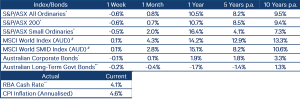
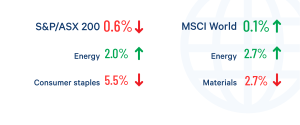
The Australian share market pulled back last week amid a steady flow of mixed headlines around tensions in the Middle East. Australian inflation rose to 4.6% annually in March, below the 4.8% consensus expectation but still the highest level since September 2023. The increase was largely driven by a 32.8% rise in fuel prices over the month. The Reserve Bank of Australia (RBA)’s preferred measure of underlying inflation, trimmed mean inflation (which removes significant one‑off price movements), held steady at 3.3%.
The Australian Federal Government outlined a number of ideas under consideration ahead of next week’s Budget, including potential changes to negative gearing, capital gains tax concessions, and the introduction of a minimum 30% tax on trust distributions. Australian government debt is expected to exceed $1 trillion next financial year.
In the US, a strong earnings backdrop supported market gains, offsetting concerns about higher energy and commodity prices. Reporting season continued with more than half of S&P 500 companies having reported earnings. London Stock Exchange Group (LSEG) estimates aggregate profit growth of 27.8% year on year. Five of the Magnificent Seven reported during the week, with results generally meeting or exceeding expectations.
The US Federal Reserve held its key interest rate steady at 3.5%-3.75%, with policymakers divided as they weighed persistent inflation pressures and awaited an upcoming leadership transition at the central bank.
Oil prices were volatile during the week, with Brent crude rising 2.7%, now up 60.1% over the past three months. Over the weekend, the President Trump rejected Iran’s latest peace proposal and warned shipping companies of sanctions if they paid tolls to Iran for safe passage as the US continues its blockade of the Strait of Hormuz.
Looking ahead, the RBA is widely expected to raise the cash rate by 0.25% (also referred to as 25 basis points) to 4.35% tomorrow. Markets will also watch for any renewed talks between the US and Iran, alongside key data including the US jobs report and Purchasing Managers’ Index (PMI) releases from China, which provide a gauge of economic activity, particularly manufacturing and services.
Macro in a minute: China’s economic pivot
In March, Australia’s core consumer price index (CPI) rose by less than 0.3%, leaving annual inflation steady at around 3.3%. While some argue this data is backward-looking and that inflation could still rise, potentially requiring further rate hikes from the Reserve Bank of Australia (RBA), there are signs of a different dynamic emerging.
A key forward-looking insight is the growing cost of living pressure on households. Prices for essentials like petrol and groceries continue to rise, while spending on non-essential items is softening. Combined with higher interest rates and only modest wage growth, this is leaving households with less room in their budgets for discretionary spending.
In simple terms, Australians are having to spend more on what they need and cut back on what they want. This weakening in consumer demand is likely to act as a natural brake on inflation, which in turn may limit how much further interest rates need to rise. In the near term, it also points to softer earnings for sectors that rely on discretionary spending.
Stock watch
NEXTDC (ASX: NXT) is a leading Australian technology company providing the critical infrastructure that underpins the digital economy, delivering secure, high‑capacity power and connectivity for global cloud providers, enterprises and government clients. After recently securing its largest‑ever customer contract, S4, NEXTDC announced a $1.5 billion equity raise, increasing its hybrid securities offer by $700 million to $1.7 billion with a binding commitment from La Caisse and increased its full‑year capital expenditure guidance to $3 billion. The capital raise provides an opportunity to materially expand contracted capacity and de‑risk the company’s development pipeline in Western Sydney. The S4 contract has lifted total contracted utilisation by around 60% to 667MW, with a further 11 data centres planned. Customer commitments are expected to generate around $1 billion in EBITDA by 2030, compared with EBITDA guidance of $235 million this year. We established our position in NEXTDC last year when the share price was oversold amid concerns around artificial intelligence demand and development uncertainty. Against a backdrop of strong demand for AI and cloud infrastructure, NEXTDC remains a critical enabler of the digital economy, with recent contract wins supporting long‑term earnings growth.
Last week, Visa (NYSE: V) reported strong quarterly results, with net revenue up 17% year-on-year, its strongest quarterly growth since 2022, or since 2013 if you exclude the post-pandemic recovery and the Visa Europe acquisition. The beat was driven by value-added services, with additional upside from higher-than-expected volatility, resilient consumer spending, and lower-than-expected client incentives. Visa raised its full-year guidance to low double-digit to low-teens net revenue growth and low-teens adjusted EPS growth, and the board authorised a new US$20 billion share repurchase program, which takes the total buyback capacity to US$33 billion. The result reinforces that Visa is a long-term winner in the evolving agentic AI-driven commerce era. Upcoming catalysts include the FIFA World Cup and LA28 Olympics, where Visa’s exclusive payments partnership should drive incremental cross-border volumes and value-added services demand.
In the media
You asked, we answered
Q. I wasn’t able to attend the 2026 National Shareholder Presentations – how can I access the content?
A. If you were unable to attend or would like to revisit the sessions, you can watch the full presentation and view the slides here. To access specific presentations, see more information below.
Geoff Wilson AO: Chairman, Chief Investment Officer and Lead Portfolio Manager
WAM Strategic Value (ASX: WAR)
- The power of compounding and why staying invested creates more value than trying to time the market
- Why managing emotions is critical to long-term investing
- Where he is seeing value today amongst LICs trading at discounts to NTA
Watch Geoff’s presentation.
Matthew Haupt: Lead Portfolio Manager
WAM Leaders (ASX: WLE)
- The use of historical analogues and why current comparisons to the 1970s oil crisis may be overstated
• The outlook for inflation, interest rates and growth in Australia
• Key opportunities across energy, LNG and volatility-driven markets
Catriona Burns: Lead Portfolio Manager
WAM Global (ASX: WGB)
- How artificial intelligence (AI) is reshaping global markets and accelerating change
- Why recent sell-offs are creating opportunities in quality companies
- Long-term themes including AI, healthcare and critical infrastructure
Watch Catriona’s presentation.
Oscar Oberg: Lead Portfolio Manager
WAM Capital (ASX: WAM), WAM Microcap (ASX: WMI), WAM Research (ASX: WAX) and WAM Active (ASX: WAA)
- Why this is one of the most challenging markets in years and how the team are leaning into current dislocation
- How short-term panic can lead to missed long-term gains
- Where they are finding high-conviction opportunities today
Damien Boey: Portfolio Strategist
WAM Income Maximiser (ASX: WMX)
- How WMX has exceeded its income and return targets in year one
- The benefits of blending debt and equity for consistent income
- The opportunities emerging as interest rates approach their peak
Nick Kelly: Portfolio Manager
WAM Alternative Assets (ASX: WMA)
- How private equity creates value through acquisition, improvement and exit
- The J-curve and why returns are realised later in the investment cycle
- How alternatives and opportunities in private markets can improve diversification and portfolio resilience
Lee Hopperton: Chief Investment Officer and Bonnie Ashton: General Manager
Future Generation Australia (ASX: FGX) and Future Generation Global (ASX: FGG)
- Explaining the Future Generation model and how to access leading fund managers on a pro-bono basis
- The construction of diversified Australian and global portfolios
- How the model delivers strong investment returns while supporting communities
Watch the Future Generation presentation.
Fund in focus

The Wilson Asset Management Founders Fund provides investors with exposure to an actively managed investment portfolio, comprised of companies listed predominantly on the ASX. The investment portfolio consists of companies with compelling fundamentals, demonstrable alignment between founders or management and shareholders; and an identified catalyst which can contribute to a rerating of the share price.
For further information, please contact Investment Specialist Chris Boyd at [email protected]
Index returns performance table