The Big Picture
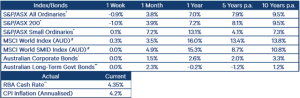
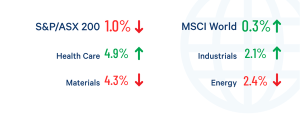
Australian equities lost ground last week, with the S&P/ASX 200 falling 0.9% on Friday as weaker commodity prices and renewed caution around global growth weighed on sentiment. Materials were the main drag, as investors rotated into more defensive areas such as healthcare and consumer staples.
Markets spent much of the week digesting developments in the Middle East. Early optimism followed news that the United States and Iran had agreed on a framework aimed at ending the conflict and reopening the Strait of Hormuz, a critical shipping route that handles around one-fifth of global oil supply. The prospect of easing energy pressures supported equities and pushed oil prices sharply lower through the middle of the week.
However, confidence in a lasting agreement weakened over the weekend. While talks between the United States and Iran resumed in Switzerland, continued unrest involving Hezbollah in Lebanon emerged as a key threat to the fragile peace process. Iran has again raised the prospect of restricting access to the Strait of Hormuz, while US officials have warned against any renewed disruption to global energy flows. Oil prices responded by moving higher at the start of the week.
On the monetary policy front, both the Reserve Bank of Australia (RBA) and the US Federal Reserve left interest rates unchanged as expected. While policymakers remain focused on inflation risks, investors are balancing those concerns against signs of moderating economic activity. Locally, the RBA reiterated that further tightening remains possible if inflation proves persistent.
Looking ahead, investors will be closely watching Australian inflation and employment data, alongside key US growth, inflation and labour market indicators. Political developments in the United Kingdom may also attract attention, with reports suggesting Prime Minister Keir Starmer is considering a timetable for his departure, adding another source of uncertainty for global markets.
Wilson Asset Management’s CGT public discussion and appearance at the Senate Economics Committee recap
|
Thank you to everyone who joined Wilson Asset Management in person or online for last week’s public discussion on the Government’s proposed changes to the Capital Gains Tax discount. More than 100 investors, business owners, industry participants and members of the public came together in Sydney, next door to the Senate Economics Committee’s inquiry into the legislation, to discuss the potential impact on investment, business confidence, entrepreneurship and the ability of younger Australians to build wealth. The discussion reinforced that this debate is about more than tax policy; it is about aspiration, fairness and ensuring Australians have the opportunity to get ahead. Attendees heard from Mark Humphery-Jenner, Chris Brycki, Derek Francis and Wilson Asset Management Chairman and Chief Investment Officer Geoff Wilson AO, with the discussion also covered by The Australian and a number of other news outlets. If you were unable to join us or would like to watch the discussion again, you can view the full recording here. Following the forum, Geoff Wilson AO appeared before the Senate Economics Legislation Committee after being added to the program late, where he presented Wilson Asset Management’s analysis of the likely impact of the legislation. You can read his opening statement at the Senate inquiry here. |

After a week of company meetings in London, it appears that while macroeconomics shocks such as war and inflation, plus the added long-term risk of artificial intelligence (AI) have had an impact, UK companies have been relatively resilient and are performing well. This hopefully will provide a great read through for Australian undervalued growth companies as we move into the 2027 financial year and the August 2026 reporting period
The macro backdrop is hardly perfect. The political environment is weak and the media narrative around the UK economy remains negative. However, on the ground, conditions appeared more resilient than the headlines imply. The UK consumer is still spending, and the companies we met were not pointing to war, freight or cost pressures as drivers of softer trading. InterContinental Hotels Group (LSE: IHG), for example, has seen little change in terms of demand and occupancy for hotel rooms outside of the Middle East which we hope resonates to one of our larger holdings in WAM Capital (ASX: WAM), Event Entertainment (ASX: EVT). Offshore trips are always a great reminder that good companies are resilient and if you take a long-term view, businesses can emerge from a tougher environment in a much stronger shape.
Similar to the Australian market, the most striking observation was valuation across the companies we saw in the UK. We saw many high-quality businesses trading on low valuation multiples, often with strong free cash flow yields, active buybacks and double-digit growth. Companies such as JD Sports (LSE: JD), Rightmove (LSE: RMV), Inchcape (LSE: INCH) and Auto Trader (LSE: AUTO) continue to demonstrate solid operating momentum yet remain priced well below comparable global peers. Echoing what we have seen in Australia over the last 12 months, we think that investors need to see stability in the macroeconomic environment and fears around AI subsiding before we see investor demand return. We think we are getting closer to this point.
The trip strengthened our conviction that AI will be a net positive, with benefits now becoming increasingly tangible. While there is no doubt some industries will be disrupted, we think those companies that lead their industry and have proprietary data will actually benefit over the longer term. Meetings with Rightmove and Auto Trader reinforced our views on REA Group (ASX: REA) and Carsales (ASX: CAR) plus other technology companies that have been hit hard over the last 12 months. Companies able to charge revenues based on the usage of AI products rather than on a per seat basis can become major beneficiaries and we remain positive on companies such as Fineos (ASX: FCL) and TechnologyOne (ASX: TNE). We also believe industries that are regulated like financial platforms like HUB (ASX: HUB) and Generational Development Group (ASX: GDG) will be protected, reinforced by our meeting with Relx (LSE: RLX).
AI is driving significant infrastructure demand, with data centre and data factory investment providing visibility for suppliers well into 2027. Europe also appears to be at a relatively early stage of this investment cycle compared to the United States. This bodes well for technology resellers in Australia sch as Data3 (ASX: DTL) and Dicker Data (ASX: DDR). Beyond AI, electric vehicle adoption remains strong across Europe as it does in Australia with no signs of slowing down. This should continue to benefit car dealer AP Eagers (ASX: APE) and novated leasing provider McMillan Shakespeare (ASX: MMS). Battery storage in Europe is a rapidly growing and increasingly important market with increased volatility experienced over the past 12 months boosting technology provider Energy One (ASX: EOL). Defence spending is accelerating meaningfully as NATO countries re-arm, with several European nations lifting expenditure. Ukraine drone manufacturers are moving into Europe to benefit from increased stocking of drone warfare with countries such as the United States and Taiwan ramping up expenditure. This tailwind will remain for Codan’s (ASX: CDA) subsidiary DTC who supplies unmanned systems.
Overall, our trip to the UK provided us further conviction on the Australian-based companies within our portfolios and reinforced an important investment lesson: poor sentiment can create attractive opportunities when company fundamentals remain strong.
In the media:

Stock Watch
Amcor (ASX: AMC) makes packaging for everyday consumer products sold around the world. Its recent Q3 update showed conditions remain soft, but volume trends are improving, with the rate of decline easing and management pointing to better trading in the US as the quarter progressed. We continue to hold Amcor as demand for essential consumer products is typically more resilient through mixed economic conditions, with synergy benefits from the Berry acquisition continuing to come through. Against a market backdrop where ceasefire talks have helped oil prices ease, any further normalisation in resin and other input costs could also support the business from here.
Synopsys (NASDAQ: SNPS) provides the essential electronic design automation (EDA) software and intellectual property required to design, test and manufacture semiconductors. Its tools enable customers to manage rising chip complexity, reduce development times and optimise performance. EDA is deeply embedded in design workflows, resulting in high switching costs and strong revenue visibility. Structural tailwinds such as AI and the proliferation of connected devices are expected to drive demand for more advanced silicon, supporting Synopsys’ sustained, long-term growth runway.
Register for Future Generation’s upcoming webinar – ‘What’s next for the Australian economy?”
This Thursday, 25 June 2026 at 2:30pm (Sydney time), Future Generation is hosting an exclusive Q&A forum with Dr Philip Lowe, Chair of Future Generation Australia (ASX: FGX) and Jennifer Westacott AC, Chair of Future Generation Global (ASX: FGG). Lee Hopperton, Future Generation Chief Investment Officer, will share an update on the investment portfolios and moderate the session. From AI advancements to economic policy and productivity, the presenters will discuss what’s next for the Australian economy. Please submit your questions for the webinar and register here.
You asked, we answered
Q. I was unable to attend the WAM Income Maximiser (ASX: WMX) webinar last week, where can I watch it?
A. If you were unable to attend, you can watch the recording here.
In the webinar, Lead Portfolio Manager Matthew Haupt and Portfolio Strategist Damien Boey discuss:
– The current positioning of the WMX investment portfolio;
– The outlook for interest rates and income following the latest RBA announcement; and
– A range of shareholder questions in an extended Q&A session
Index returns performance table